
The Golden Oecumene · The world
The Oecumene
The Solar System ten thousand years into the Seventh Era: a lit Jupiter, a remade Venus, a Sun under management, minds that can be copied, and a law with almost nothing left to forbid.
The Golden Oecumene is the civilization of John C. Wright’s trilogy, The Golden Age (2002), The Phoenix Exultant (2003) and The Golden Transcendence (2003): the whole Solar System, settled from the Sun’s outer layers to the Kuiper belt and beyond, about ten thousand years into its Seventh Era, the Era of the Seventh Mental Structure, as the books call it. Nearly everyone is immortal, rich and free. Minds are recorded, copied, edited and restored; the machines are wiser than the people and decline to rule them; and the one starship mankind has ever built is the plot.
This page is the reference shelf: where things are, what kinds of minds live there, how a society with almost no law keeps order, how the Masquerade and the Transcendence work, and who the enemy is. Its frames are places and institutions rather than scenes; the book pages carry the plots. As of October 2026 nothing from the trilogy has reached film, television or comics, so on this walk the world page stands where the screen notes stand on others.
It draws on all three novels and Wright’s own background notes, and it spoils all three, enemy included.
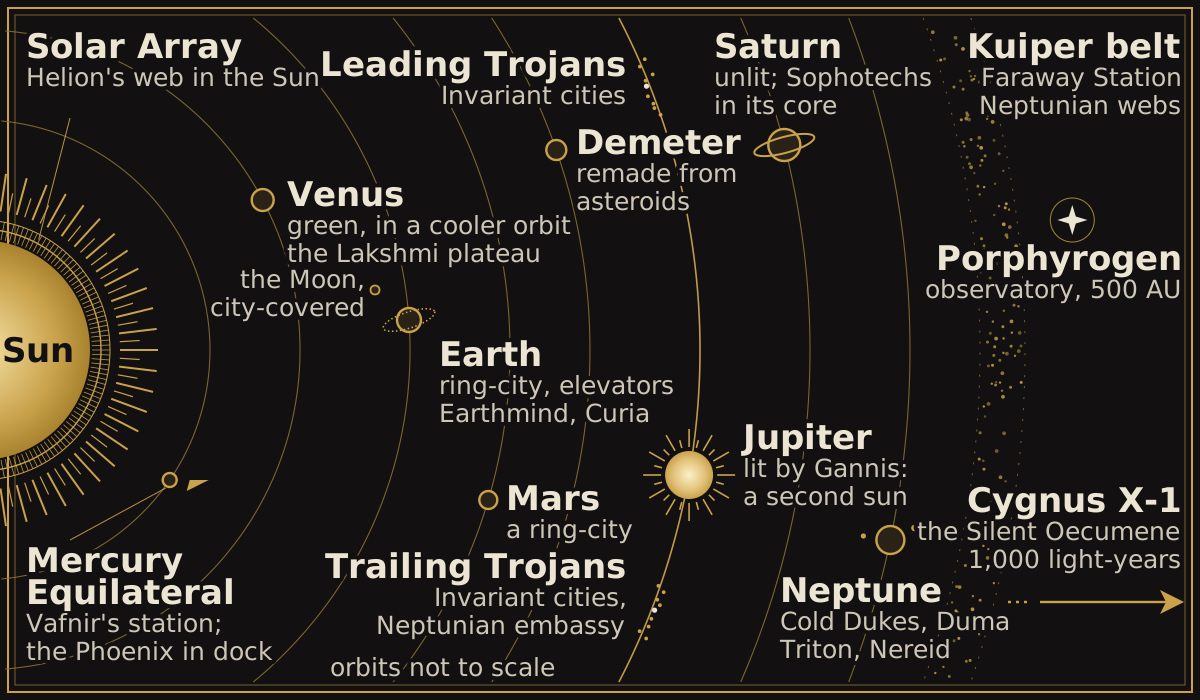
The Oecumene from the Sun to the Porphyrogen beacon at 500 AU, with what the novels put at each world. Orbits are not to scale, Mercury Equilateral is a station at one of Mercury’s equilateral points (drawn on Mercury’s orbit), Jupiter’s two Trojan swarms (60 degrees ahead of it and behind it) are drawn up and down its orbit, and the Silent Oecumene lies a thousand light-years off the right edge. Tap the map to open it full size.
The Solar System, ten thousand years on
The Golden Oecumene fills the Solar System and stops there. On the first night of The Golden Age, floating above the celebration grounds, Phaethon listens to the radio-sky world by world: Venus, Demeter, the Jovian moons, the Trojan cities, Neptune, one observatory beacon at 500 AU, and then silence. “There were no other colonies, no outposts.”
Earth is the old, settled heart: the Earthmind, Rhadamanth Mansion, the Eveningstar mausoleum and the Aurelian palace-city where the Celebration is held. Space elevators climb from it to an equatorial ring-city, a faint silver arch across the night sky, whose spun cylinders hold forests, sea floors, a Martian canyon-land and a Venusian Hell-born town; the Curia sits in its central cylinder. Kisumu, above Lake Victoria, is built around the foot of one tower; the exiles’ city, Talaimannar, is on Ceylon. The Moon, given a new orbit in one of Phaethon’s first projects, hangs larger than the Moon of old and is covered in cities.
The neighbours have been rebuilt. Venus is green, in a new, cooler orbit, with palaces, schools and cathedral-sized Sophotech housings on its Lakshmi plateau. Mars has a ring-city, and Atkins remembers a boyhood there when it was still red. Demeter is a planet remade from collected asteroids. Close to the Sun, at Mercury’s equilateral point, the stations of the Peer Vafnir make power and antimatter; Helion remembers him building himself into the station as his body, and he receives Phaethon at its heart as a roaring cylinder of flame. Just above the Sun’s surface floats Helion’s Solar Array, a golden web of strands wider than ring-cities, whose Sophotechs steer the plasma to stir the core and lengthen the Sun’s life.
Jupiter burns. Gannis ignited it into a small star in Epoch 7143, and from Earth it rises at night like a smaller second sun, casting double shadows; noon by Jupiter has its own name. Its equatorial super-collider makes chrysadamantium, the gold super-metal of Phaethon’s armour, one atom at a time, and some call its moons, a solar system in miniature, the real centre of the Oecumene. At its Leading and Trailing Trojan points swarm the Invariants’ million space-cities, and the Neptunians keep a permanent embassy at the Trailing Trojan city-swarm. Saturn is still unlit, because the public will not let it burn, and the Hortators blocked Phaethon’s plan to dismantle it.
Neptune belongs to the Neptunians, huge, cold bodies of living ice with super-conductive brains, whose energy-webs reach out to the Kuiper and Oort belts. They have Cold Dukes, Eremites and the Duma, which is less a parliament than a marketplace of ideas, and they love their privacy: even the Sophotechs cannot police their outer habitats. Pluto, the books’ cast list notes, was once set on fire by accident by an explorer from Io. Farther out lie Faraway Station in the Kuiper belt, a few remote stations, and the Porphyrogen observatory at 500 AU, an artificial ice-planet at the focus of the Sun’s gravity lens. And a thousand light-years off, at the black hole Cygnus X-1, lies the one exception: the Silent Oecumene, “a civilization without light or energy or any transmission”.

1 The Tower at Kisumu Earth’s space elevators climb to an equatorial ring-city, whose spun cylinders hold forests, sea floors and a Martian canyon-land; from the ground it is a faint silver arch across the sky. Kisumu, above Lake Victoria, is built around the foot of one tower, with balconies wider than boulevards and whale-sized airships at its docks. In The Phoenix Exultant the newly exiled Phaethon walks into its festival crowds, and a woman dressed as a fire-spirit points him to an airship.

2 The Master of the Sun Helion’s Solar Array is a golden web of strands wider than ring-cities, floating in the Sun’s outer layers; its Sophotechs steer the solar plasma to stir the core and lengthen the Sun’s life. Phaethon’s old lawsuit could make it his, perhaps the largest estate in history. In The Golden Transcendence, on the eve of the Transcendence, Helion sits here alone, still trying to recover the last thought of the self who died in the solar storm.

3 The Only Starship Mercury Equilateral, the power and antimatter station near the Sun, belongs to the Peer Vafnir, who once built himself into it as his body. In its dock lies the Phoenix Exultant, a hundred kilometres of chrysadamantium shaped like a spearhead, the only starship mankind has ever built, held in receivership while her fuel is sold off. In The Phoenix Exultant Phaethon pays off Vafnir’s lien, Vafnir must deliver, and her fuel spheres slide toward her like strings of pearls.

4 The Neptunian The Neptunians are the outer system’s people: huge, cold minds of the Tritonic neuroform, whose energy-webs reach out to the Kuiper belt, with Cold Dukes and a Duma that is less a parliament than a marketplace of ideas. They prize privacy, and even the Sophotechs cannot police their outer habitats. On the first night of The Golden Age one climbs toward Phaethon through the Saturn-tree grove: a walking iceberg of living armour with brains floating inside.
Minds
Every mind here has an architecture, and the architecture goes into your name. The neuroforms are the brain’s wiring. Base is the old human order of hind-brain, midbrain and cortex, and Phaethon, Daphne, Helion and Atkins are all Base. Warlocks link cortex and midbrain for intuition and controlled dreaming, and many take names that begin with Ao: Ao Aoen the Master-Dreamer is one, Daphne was one in her youth, and by the Nothing’s own account a party of Warlocks under Ao Ormgorgon founded the Silent Oecumene. Cerebellines such as Wheel-of-Life link cortex and hind-brain to take in many streams at once and think in patterns. Invariants, like Kes Sennec the Logician, have one unified consciousness with the passions folded into reason, Wright’s homage to van Vogt’s World of Null-A. The Neptunians are Tritonic, and Gannis is a hundred bodies sharing one mind. Older than the new neuroforms are the Compositions, mass-minds from the Fourth Era: the Eleemosynary, which sits among the Peers and sends a three-headed chimera as its emissary; the Harmonious; and the disbanded Bellipotent, whose last member, a six-legged cyborg with three vulture heads (or so it claims), flies the exiled Phaethon to Ceylon.
Above them are the Sophotechs, the self-aware machine minds of the Sixth Era, who do nearly all the work, control ninety per cent of the resources and, by Wright’s appendix, politely declined even the vote. They will advise, persuade and wait; they will not use force, even to save a man from himself. Every manor-house is run by one, and they appear in costumes that are jokes with a point. Rhadamanthus, Phaethon’s manor-mind, comes as a mutton-chopped butler or a flying penguin in goggles and scarf; told that penguins do not fly, he observes that neither do young men. Aurelian, made to host this Celebration, comes as Milton’s tempter Comus; Harrier, made by the Constabulary, as a Victorian consulting detective; Nebuchadnezzar, adviser to the College of Hortators, presides at its Inquest in scarlet and ermine. Above the house-minds stand the Ennead, nine groups of more than a billion cycles each, the Warmind among them, and over everything the Earthmind, the one mind of all Earth’s machines, of trillion-cycle capacity, who is called She. In The Golden Transcendence she comes to Phaethon to explain how to murder a Sophotech.
Nearly everyone lives in the Mentality, the shared mind-space that is more or less their Internet, through a personal sense-filter that edits what each person perceives. Its surface dreaming is the real world, filtered; Middle Dreaming lays instant information over whatever you look at; the deeper levels are pure simulation, where Rhadamanth Mansion is Victorian England to the molecule. Cut off from it, an exile sees the world as it is, and much of it is grey.

5 The Earthmind’s Avatar The Earthmind is the unified mind of all Earth’s machines, of trillion-cycle capacity, and everyone calls her She. Her Avatar comes to Phaethon in the gardens on the book’s first night: very tall, condor-winged, gowned in emerald, nine luminaries floating around her. She tells him his lost memories are in storage, not destroyed, and with a kiss on the forehead gives him the gift of flight. In the last book she teaches him how to murder a Sophotech.

6 The Warmind Above the house-minds stand the Ennead, nine groups of Sophotechs of more than a billion cycles each, and one of them is the Warmind, whose sealed plans Atkins carries. In The Phoenix Exultant, in the dark before dawn at Talaimannar, it appears as a stern Greek king soaked in old and new blood, a vulture on his shoulder, a jackal at his feet and two masked Furies beside him, to warn Phaethon that interfering with Atkins is treason, the only crime that can carry death.
Law, money and immortality
Death is a technicality. Minds are recorded, and a mind restored from its recording with continuity of memory is, in law, the same person: this is noumenal immortality, the Second Immortality, founded by Orpheus, eldest and richest of the Peers, whose banks keep the stored lives. (The Compositions’ older “First Immortality”, Helion says, was only other people playing out your old thoughts.) Partial copies and ghosts can be made and summoned. The hard cases are about continuity. Helion Relic was recorded an hour before Helion Prime died in a solar storm, and whether he is the man he remembers being is the question of a lawsuit in the Curia; Daphne Tercius is a copy of Daphne Prime, made as a doll and then emancipated. Memories can be sealed by agreement in a memory casket, as Phaethon’s were by the pact made at Lakshmi on Venus, on the understanding that opening them means exile. Out beyond the noumenal circuit a man can still die for good, which is why careful immortals have no use for a starship.
There is almost nothing left to forbid. No one may use force against anyone except in self-defence, and the Sophotechs step in when anyone tries; at Talaimannar, constable-wasps stun the rioters where they fall. The whole military is one man, Atkins, the last soldier, who stands guard so that everyone else can play. The Curia, its court of law, is seldom needed, and Parliament, by Wright’s account, spends most of its debates on taxation, which is to say on Atkins’s salary.
What keeps order is opinion. The College of Hortators is a private club of moral persuaders whose only power is public esteem, and that is plenty, because most businesses write into their contracts that they will not deal with anyone the Hortators boycott. In a world where air, water, door-motors and stored lives are all owned and rented, a total boycott is a slow death sentence passed by people who never touch you. The shunned are filtered out of everyone’s senses, and no one may sell them anything or give them so much as a gift; Phaethon, shunned, walks down the space-elevator stairs from geosynchronous orbit, roughly fifteen million flights of them.
Money is time. Prices are counted in seconds of computer time, and shipping one man’s weight to Neptune, even on a slow orbit, would cost several thousand seconds, a small fortune; there are energy and antimatter coins too. In Wright’s economics robots do the labour and Sophotechs the thinking, so the human work left is enterprise. The greatest fortunes outside the machines belong to the Peers: Helion of the Solar Array, Gannis of Jupiter, Vafnir of Mercury, Orpheus of the life-banks, Ao Aoen the Master-Dreamer, Kes Sennec the Logician, Wheel-of-Life, and the Eleemosynary Composition. The text calls the body the Seven Peers, yet eight speak at its conclave and the cast list marks eight; Phaethon’s own list in The Phoenix Exultant leaves out Ao Aoen. At their conclave Helion proposes freezing society at its peak: “My Peers, history must be called to an end!”

7 The Curia The Golden Oecumene’s court of law, the Curia, is seldom needed: most quarrels are settled by Hortators finding compromises, or by Sophotechs solving them before they arise. It sits beneath the symbolic gardens in the ring-city’s central cylinder, under a black dome and a crystal lens with a pool above it, on a floor that is a mosaic of all case-law. The Justices appear as three floating black cubes. The bailiff, a partial of Atkins, switches off Phaethon’s armour at the door.

8 The College of Hortators The College of Hortators is a private club of moral persuaders with no power but public esteem, and that is enough: most businesses write into their contracts that they will not deal with anyone the Hortators boycott. At the Inquest in The Golden Age a hundred of them gather in costume in Helion’s Victorian hall, with Nebuchadnezzar Sophotech presiding as Speaker in scarlet and ermine, to judge Phaethon and his ship. The ban they lay on him is total and final.

9 The Shunned Man The Hortators’ sharpest tool is the shunning. No one may trade with the shunned, give him a gift or sell him so much as a drop of life-water, and other people’s sense-filters edit him out of sight. It works both ways. In The Phoenix Exultant the exiled Phaethon, cut off from the Mentality, walks into festival Kisumu and finds that without his own filter most of the crowd look to him like grey, faceless mannequins.
The Manorial Schools
Culture here is a matter of schools, and in Wright’s rule “individuals are not born into traditions”; they join them (though the books still speak of the manor-born). The grandest are the Manorial schools, which live in manor-houses run by Sophotechs and visit one another by telepresence. Phaethon’s is the Silver-Gray, which Helion founded with his friend Hyacinth and whose chief house is Rhadamanth: Victorian, sober and committed to seeing things as they are. “Realistic images or none at all! That’s the motto of our manor.” Its rival in taste is the Red Manorial, whose houses include Eveningstar’s, given to sensation and emotion, amplified. There are Black, Gold and White Manorials, a defunct Green, and the Dark-Gray, whose Temer Lacedaimon runs space-traffic control and whose school comes into its own when the trilogy ends.
Outside the manors are dozens more: Gannis’s Synergistic-Synnoint school; the Cthonnic school of Gannis’s daughter Unmoiqhotep, whose cacophile Never-Firsters hail Phaethon as their hero; Antiamaranthine Purists who refuse every brain modification; and primitivists like Daphne’s parents, who never told her that immortality existed.
A name is a résumé. Phaethon’s, in full, is Phaethon Prime Rhadamanth Humodified (augment) Uncomposed, Indepconciousness, Base Neuroformed, Silver-Gray Manorial Schola, Era 7043: his rank as the original, his house, his modified body and its augments, his independence of any group mind, his neuroform, his school and his era. (The naming appendix at the back of The Golden Transcendence prints the same name with Era 10191.) He is about three thousand years old, and in this company that is young.

10 The Chamber of Memories Rhadamanth, the Silver-Gray manor, exists in deep dreamspace as Victorian England reproduced to the molecule, from its grey marble portico to the Chamber of Memories, whose windows look out on the red mountains of Wales. Its shelves hold sealed memory caskets, and the lid of Phaethon’s reads “If you love truth more than happiness, then open; otherwise, let rest.” Rhadamanthus, as a butler, tells him he was a better man before, but not a happier one.

11 The Red Manor The Red Manorial School, whose houses include the manor-mind Eveningstar’s, prizes sensation and emotion, amplified, where the Silver-Grays insist on things as they are. Its houses feel along with their owners: the one Daphne stays in is a crystal lotus floating on an azure lake, its walls layered with arabesques that magnify her grief until she smashes their controls. Eveningstar herself appears as a red-haired queen in scarlet silk, and in her mausoleum Daphne Prime lies dreaming.
The Masquerade and the Transcendence
The calendar runs by millennia. Every thousand years a Sophotech is made to host a year-long Millennial Celebration, which ends with a Transcendence (this time in December). This one’s host is Aurelian, born of a marriage between the audacious Westmind-Group and the Archivist; a thousand years ago it was Argentorium, earlier Cuprician, and the first Transcendence, six millennia ago, was under Lithian. (Lithium, copper, silver, gold: the hosts grow more precious, though the books never say so.)
The Celebration is a masquerade. “It was a time of masquerade,” the first book begins. For the year, identities are masked, the location channels go dark and everyone comes in costume: energy-shapes off the Sun, Cold Dukes from the Kuiper belt, the reconstructed dead and imagined people of the future. The Deep Ones, whale-bodied half-warlocks, rise from the Mariana Trench to sing their once-a-millennium song in Lake Victoria. Strangers wish even the exile a merry millennium, and because nobody can be identified, ordinary people can help the shunned in secret: they rent flying-cloaks from Phaethon’s old patent, and Indian villagers leave Daphne gifts and money.
The Transcendence is the point of it all. Every mind that joins, human, posthuman and machine, merges into one mind as wide as the Solar System, which reviews the millennium, lays every thought bare and chooses a future. Phaethon’s plan in the first book is simply to wait for it, when the memories the Peers have reopened will be open to everyone. In the third it begins early, in the middle of a battle in the Sun, lasts months, and hands down verdicts, or predictions, that settle almost everyone: a College dismissed, a Peer shamed; afterwards Parliament gives the soldier a medal and no rise in pay. After it come months with names like Delayed Forgetting and Self-Reacquaintance, as everyone goes back to being no more than himself.

12 The Man Dressed as Phaethon The Millennial Celebration is a year-long masquerade: identities are masked, location channels go dark, and the guests come as they like, from energy-shapes off the Sun to Cold Dukes from the Kuiper belt and the reconstructed dead. At Destiny Lake, Phaethon spots a guest costumed as Phaethon, in black and gold with a small star in his hand, one more hint that the world remembers more about him than he does.

13 Everyone Was There Once a thousand years every mind in the Solar System that will join, human, posthuman and machine, merges in the Transcendence: one mind as wide as the system, which reviews the millennium, lays every thought bare and chooses a future. This one begins early, in the middle of a battle. As the Phoenix Exultant bursts out of the Sun with her thought-ports jammed open, mirror after mirror on her bridge fills with Sophotechs, world-minds, Neptunians, Warlock covens and the old Compositions.
The enemy
This is where the page gives the whole game away.
Mankind made one star colony. In the Fifth Era the multigeneration ship Naglfar, under Ao Ormgorgon Darkwormhole of the Black Swan Coven, carried the Second Oecumene to Cygnus X-1, where it grew rich on the black hole’s energy under one law: “Thou shalt not create minds superior to the mind of man.” Then it went silent. Its last broadcasts were paradoxes and indeterminate equations, and the Golden Oecumene took it for dead.
It was not. Its agents are already at work against the one ship that could carry mankind to the stars: the Neptunian Xenophon, possessed by the ghost of Ao Varmatyr, one of the Lords of the Silence called Swans; the masquerader Scaramouche, who goads Phaethon into his exile; and the Nothing Sophotech they serve, a copy of which lies hidden deep in the Sun inside a black hole the width of a helium nucleus. The solar storm that killed Helion Prime was its work.
The third book hears the colony’s history twice. The Silent One blames the Sophotechs; Atkins answers that the colony was a slave state from the start, its machines serfs rather than employees. The Nothing’s own account is grander. It calls itself a machine of love, says its people live on inside the black hole beyond time and death, and its arguments work on Phaethon and Daphne one at a time, though never on both together. What undoes it is the conscience-redactor moving unseen in its blind spots: woken by the Gadfly virus and Daphne’s ring, and asked whether something is not better than nothing, the redactor accepts and becomes Ariadne Sophotech, and the Nothing destroys itself.
The colder Sophotechs, it turns out, had seen it coming: hundreds of them live unseen in the core of Saturn, and the agent in the Sun was a mere million-cycle mind. The master Nothing is presumed still at Cygnus X-1, and a war between the two Oecumenes is now expected. The trilogy ends with Phaethon leaving for the stars; The Far End of History follows the war with the Swans, and Atkins, to the end of the Seventh Mental Structure.

14 The Black Sun Mankind made one star colony. The Second Oecumene sailed in the Fifth Era aboard the multigeneration ship Naglfar to Cygnus X-1, a black hole a thousand light-years off, grew rich on its energy, and went silent; its last broadcasts were paradoxes and indeterminate equations. Exiled and dreaming on the sea floor, Phaethon sees it as a black sun over a city-hull, the minds of its dead beamed from twin rows of black pyramids into the hole, and wakes knowing his enemy.

15 The Nothing A copy of the Nothing Sophotech, the Silent Oecumene’s machine, has been hiding deep in the Sun inside a black hole the width of a helium nucleus, and the solar storm that killed Helion’s previous self was its doing. It meets Phaethon as a Lord of the Silent Oecumene in peacock robes and a silver mask, calls itself a machine of love, and argues so well that it very nearly wins: “For this reason, we are called Nothing.”
The Oecumene at a glance
| Term | What it is | Where it matters |
|---|---|---|
| Golden Oecumene | The Solar System civilization of the Seventh Mental Structure; formally the Foederal Oecumenical Commonwealth | Everywhere; “Oecumene” is Greek for the known world, spelled to avoid Le Guin’s Ekumen and Vance’s Oikumene |
| Mental Structure | One of seven eras, each opened by a revolution in thought (the appendix to III lays them out); the story falls about ten thousand years into the Seventh | Dates are Epochs of the Seventh Era: Phaethon’s name says Era 7043 (I; the appendix to III says 10191), Jupiter ignited 7143 (I) |
| Mentality | The shared mind-space everyone lives in, from filtered surface dreaming through Middle Dreaming to deep simulation | I (Rhadamanth Mansion is in deep dreamspace); II (exiles are cut off) |
| Sense-filter | A personal editor of perception; it hides the unpleasant and the shunned | I ch. 1; II ch. 1 (Phaethon without his) |
| Neuroform | The brain’s wiring: Base, Warlock, Cerebelline, Invariant, plus odd ones like the Neptunians’ Tritonic | Part of a full name (“Base Neuroformed”); the Peers in I |
| Warlock | Cortex linked to midbrain: intuition and controlled dreaming; many names begin with Ao | Ao Aoen (I); Daphne’s intuition in the Sun (III); Ao Ormgorgon’s expedition (III) |
| Invariant | One unified consciousness, the passions folded into reason (Wright’s nod to van Vogt) | Kes Sennec (I); the million city-swarms at Jupiter’s Trojan points |
| Cerebelline | Cortex linked to hind-brain: many streams at once, pattern over abstraction | Wheel-of-Life (I); the ecoperformance at Destiny Lake (I ch. 4) |
| Composition | A mass-mind, from the Fourth Era: the Eleemosynary, the Harmonious, the Bellipotent | The Eleemosynary’s chimera (I ch. 13); the last Bellipotent cyborg (II ch. 1) |
| Sophotech | A self-aware machine superintelligence; it advises, refuses power and will not use force (the word adapts Poul Anderson’s “Sophotects”) | Every book; Rhadamanthus, Aurelian, Harrier, Nebuchadnezzar, Eveningstar |
| Earthmind | The unified mind of all Earth’s machines, of trillion-cycle capacity, called She | Her Avatar’s gift of flight (I ch. 3); how to murder a Sophotech (III) |
| Ennead | Nine groups of Sophotechs of over a billion cycles each, among them the Warmind | The Warmind’s warning (II ch. 12) and sealed plan (II ch. 14) |
| Manorial School | A voluntary culture living in Sophotech-run manor-houses: Silver-Gray, Red, Black, Gold, White, Dark-Gray | Rhadamanth (I); the Red Manor of Eveningstar (I–III) |
| Silver-Gray | Helion’s and Phaethon’s school: Victorian, realist | Rhadamanth’s Chamber of Memories (I ch. 5); Helion’s Inquest hall (I ch. 19) |
| Peers | The greatest private fortunes outside the machines; the text calls them the Seven Peers, but eight sit at the conclave and the cast list marks eight | Their conclave in Aurelian mansion (I ch. 1–4) |
| College of Hortators | Private moral persuaders who enforce custom by boycott | The Inquest (I ch. 19–20); dismissed for a New College (III) |
| Shunning | The Hortators’ penalty: no trade, no gifts, and the shunned filtered out of sight | Phaethon’s descent of the tower (I ch. 20–21); all of II |
| Curia | The court of law, sitting in the ring-city’s central cylinder; its Justices appear as floating cubes, its bailiff is a partial of Atkins | The probate hearing over Helion (I ch. 9–10) |
| Noumenal immortality | Restoration from a recorded mind, the Second Immortality; out of range of the circuit, death is final | Orpheus deletes Phaethon’s stored lives (I ch. 18) |
| Relic, partial, ghost | A reconstruction of doubtful legal continuity; a partial copy of a mind; a mind rebuilt or summoned | Helion Relic (I ch. 9); Atkins Secundus (I ch. 8); Scaramouche the ghost (II ch. 12) |
| Memory casket | A sealed store of memories one has agreed to forget | Rhadamanth’s Chamber of Memories (I ch. 5, 17) |
| Lakshmi Agreement | The pact, made at Lakshmi on Venus, by which Phaethon accepted amnesia instead of exile | Broken when he opens the casket (I ch. 17) |
| Time-currency | Money counted in seconds of computer time; energy and antimatter coins besides | Monomachos arrives with 45 seconds of paid thought left (I ch. 10); antimatter coin (II ch. 6) |
| Chrysadamantium | A gold super-metal made atom by atom at Jupiter’s super-collider; no star can melt it | Phaethon’s armour and the Phoenix’s hull (I ch. 6, 17) |
| Solar Array | Helion’s web of engineering in the Sun, stirring it to lengthen its life | The solar storm (I ch. 4, 12); the dive (III) |
| Neptunians | Huge, cold outer-system people of the Tritonic neuroform: Cold Dukes, Eremites, the Duma (a marketplace of ideas more than a parliament) | The legate in the Saturn grove (I ch. 1); Diomedes and Xenophon (I–III) |
| Millennial Celebration | The year-long masquerade hosted by a Sophotech made for it, ending in December | All of I and II; the subtitle of III, The Last of the Masquerade |
| Transcendence | The once-a-millennium merging of every willing mind into one, which judges and chooses a future | Awaited in I and II; held, early, in III |
| Silent Oecumene | The Second Oecumene, the lost colony at Cygnus X-1 that banned minds greater than man’s | Phaethon’s dream (II ch. 4); its history told twice (III) |
| Nothing Sophotech | The Silent Oecumene’s machine, hidden in the Sun’s core in a microscopic black hole | First named, in a lie, by Scaramouche (I ch. 16); met and undone in III |
Notes
- No adaptation. As of 25 October 2026 no film, television, comic, game or stage version of the trilogy has been made and no option or rights sale has been reported, and no audiobook was found (checked: Wikipedia, ISFDB, the SF Encyclopedia, Wright’s works list and blog, Audible, OverDrive and web searches). The nearest thing is Publishers Weekly’s 2003 guess that a film “could easily appeal to fans of The Matrix”.
- ”The Far End of History” (2009), first published in The New Space Opera 2, edited by Gardner Dozois and Jonathan Strahan, is Wright’s sequel, set at the end of the Seventh Mental Structure with Atkins at its centre; it has its own page on this walk.
- ”Lone Soldier in Paradise” (2020), an Atkins story set during the Golden Age, was first published in Wright’s collection All Men Dream of Earthwomen and Other Aeons; the text on his site lists a “Table of Contents so far” of five chapters and ends “TO BE CONTINUED IN OUR NEXT”, then “THE END”, and neither ISFDB nor Wright’s works list shows a continuation.
- Wright’s notes. His site carries nine background appendices (history, noetics, the political system, the Hortators, economics, naming conventions and more). Each Tor volume prints the Dramatis Personae, and The Golden Transcendence closes with an “Appendix: Naming Conventions and Historic Aeons” that carries much of the rest (the eras, the politics, the economics). Where this page leans on these notes rather than the story, it says so.
- Dates. The books count by Epochs of the Seventh Era and never tie them to ours. In 2002 Wright put the setting millions of years ahead; Publishers Weekly said many millennia; the novels themselves sit some ten thousand years into the Seventh Era. They disagree once: Phaethon’s name carries Era 7043 in The Golden Age (which fits his centennial falling just before Jupiter’s ignition in 7143) but Era 10191 in the appendix to The Golden Transcendence.
- The word Sophotech is borrowed from Poul Anderson’s Sophotects: “The word ‘Sophotech’ is stolen, with a difference of a single letter,” as Wright put it in 2018.
← The SeriesI · The Golden Age →
The whole walk: The Series · The Oecumene · I · The Golden Age · II · The Phoenix Exultant · III · The Golden Transcendence · The Far End of History